
Have you noticed something strange?
Open any major company’s earnings call, and CEOs can’t stop talking about AI. 306 companies in the S&P 500 mentioned AI in their Q3 earnings calls. By Q4, AI became the top topic, appearing in 47% of meetings.
Mentions of “Agentic AI” and “digital workforce” surged 779% year-over-year.
But shift your gaze from the slides to reality, and it’s a completely different story.
56% of companies admit: after all that AI investment, they’ve seen no significant returns.
PwC’s survey shows only 10-12% of companies reported meaningful AI benefits. MIT’s research is even more damning—the failure rate of enterprise AI pilots is 95%.
It’s like buying a gym membership—full of enthusiasm at purchase, but the card sits in a drawer collecting dust after a month.
So today I want to talk about something everyone cares about but few have explained thoroughly: How is AI actually reshaping the job market? Who’s winning, who’s losing, and what should you do?
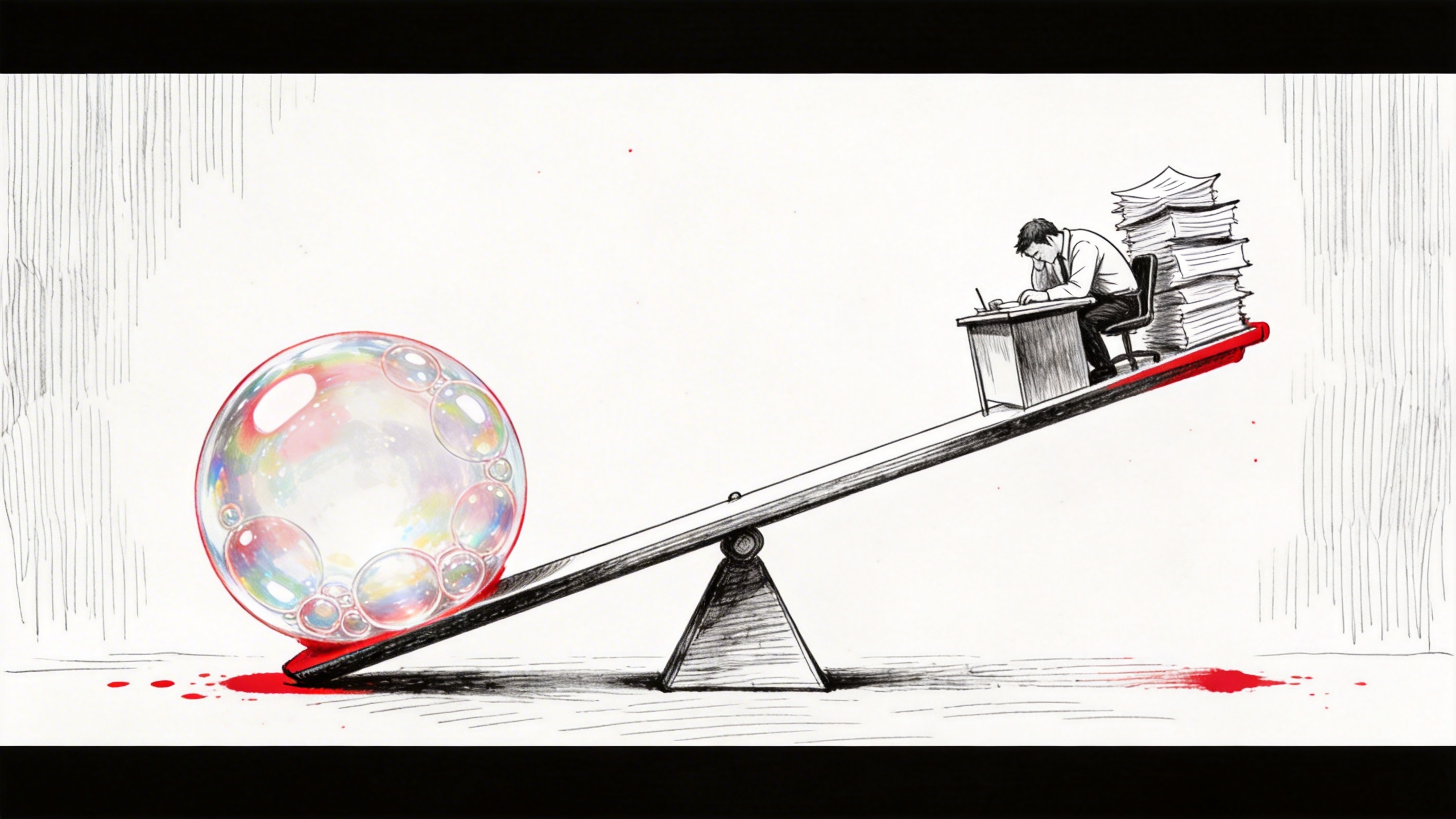
The Ugliest Move: AI-Washing Layoffs

Let’s start with the most uncomfortable part.
Forrester Research coined a term that’s painfully accurate—“AI-washing.”
What does it mean? Some companies use AI as an excuse to lay off workers when the cuts have nothing to do with AI.
A few cases make it crystal clear:
- Dow: Laid off 4,500 people citing AI
- Pinterest: Cut 15% of staff while admitting their platform was flooded with AI-generated spam
- Salesforce: Eliminated 4,000 customer service positions, claiming AI had handled 30-50% of the workload
Even more absurd: 44% of employers claim they’ve provided AI training, but in reality? Only 33% of employees confirmed receiving any training.
They tell you “AI replaced your job” while firing you, but never even gave you AI training.
This isn’t a tech revolution—it’s cost-cutting disguised as innovation.
The result? Gen Z’s confidence in their skill preparedness plummeted 20 percentage points to 39%.
Young people aren’t unwilling to learn—they can’t even see which direction to go.
But Some Companies Are Actually Making Money with AI

Done with the fake stuff. Let’s look at what’s real.
Some companies have achieved rock-solid results with AI, backed by hard numbers.
Klarna: A Textbook AI Transformation
This Swedish buy-now-pay-later company is the most aggressive AI practitioner I’ve seen:
- Headcount dropped from 5,000 to 3,000
- But revenue doubled
- Revenue per employee skyrocketed from $575K to nearly $1M, up 152%
- 96% of employees use AI daily
Note: it’s not that the company fell apart after layoffs. After the cuts, every remaining employee became a super-individual.
Hiscox: An Efficiency Revolution in Insurance Claims
- Claims processing dropped from 60 minutes to 10 minutes
- Complex underwriting went from 3 days to 3 minutes
From 3 days to 3 minutes. That’s not improvement—that’s evolution.
Programming: AI Now Writes 41% of Code
- GitHub Copilot and other coding assistants improve task completion by 55-81%
- In 2025, 41% of code was written by AI
Customer Service: Bank of America’s Erica
- Handled 2 billion customer interactions
- 98% of issues resolved within 44 seconds
Daily Productivity with Enterprise AI Assistants
- Average users save 40-60 minutes per day
- Power users save 10+ hours per week
Truly effective AI applications aren’t about “replacing humans with AI” but “making humans stronger with AI.” Klarna’s doubling of per-employee revenue wasn’t because AI did people’s work—it was because human + AI became a super-combination.
Entry-Level Workers: The Most Wounded

After seeing the data, you might think “AI seems great.”
But if you’re a recent graduate, you probably can’t smile.
Entry-level job postings have dropped 35% since January 2023.
Breaking it down by industry is even more alarming:
- IT entry-level hiring fell from 25% in 2023 to just 7% in 2025
- Financial entry-level positions dropped 24%
- For the first time in 45 years, college graduate unemployment exceeds the national average
Even more absurd: 35% of so-called “entry-level” positions now require 2-3 years of experience.
Entry-level requiring 2-3 years of experience? How is that entry-level?
Anthropic CEO Dario Amodei warned: AI could eliminate 50% of entry-level white-collar jobs within 5 years.
The IMF Managing Director called it an “AI tsunami” targeting young people.
The logic behind this is brutal: companies used to need junior employees for data organization, report writing, and basic coding. Now AI can do it.
So what’s the point of junior employees?
Here’s the problem: if there are no entry-level positions, where do mid-level and senior talent come from?
The hiring costs saved today could become tomorrow’s talent gap.
Macro Data: Not as Bad as You Fear, Not as Good as You Hope
A few macro data points to give you the big picture.
World Economic Forum predicts: By 2030, AI will create 170 million jobs and eliminate 92 million, for a net gain of 78 million. ITIF data corroborates this: in 2024, AI created 10x more jobs than it displaced.
But Yale Budget Lab research offers a sobering comparison: career changes since ChatGPT launched are only 1 percentage point higher than the internet era.
Macro data looks fine, but the problem is extremely uneven distribution.
AI isn’t killing jobs—it’s reshuffling the deck. Some people got dealt a royal flush; others didn’t even get to draw cards.
Plot Twist: Blue-Collar Workers Are the Winners

This might be the most counterintuitive part of the entire AI employment story.
Jensen Huang called data center construction “the largest infrastructure build in human history.”
McKinsey predicts that by 2030, the US will need:
- 130,000 electricians
- 240,000 construction workers
- 150,000 construction supervisors
Wages for AI-related construction jobs have nearly doubled.
Picture this: programmers worry about being replaced by AI, while electricians on construction sites see their wages double thanks to data center construction.
The jobs hardest for AI to replace are becoming more valuable precisely because of AI’s infrastructure demands.
2030: The Pyramid Is Flipping

McKinsey painted a picture of the 2030 workforce—it’s quite striking:
The pyramid is inverting.
- Senior employees become more valuable: McKinsey predicts 3.8 million new high-paying jobs
- Middle management gets squeezed: Amazon is reducing organizational layers; manager headcount at public companies has already dropped 6.1%
- Entry-level faces the deepest cuts
Scott Galloway put it sharply:
“AI is targeting middle management first. The question is no longer whether AI will replace jobs, but how you keep yours.”
Key data points:
- Gartner predicts that by 2030, virtually no IT job won’t require AI assistance
- 75% of white-collar work will be AI-augmented, 25% fully AI-completed
- Low-wage workers are 10 to 14 times more likely to need career transitions than high-wage earners
- HR staff expected to decrease 30% by 2026
Three Schools of Thought: Where Do You Stand?
On AI and employment, there are roughly three camps:
Optimists: Every technological revolution in history created more jobs. 60% of American workers today hold jobs that didn’t exist in 1940. AI will be the same—spawning careers we can’t yet imagine.
Pessimists: This time is different. Previous automation targeted physical labor; this time we’re automating intelligence itself. When thinking can be done by machines, what’s left for humans?
Realists: Don’t be extreme. Two-thirds of jobs will see partial automation, and winners versus losers depend on industry, skills, and adaptability. It’s not “everything disappears” or “nothing changes”—it’s a massive reshuffle.
I personally lean realist.
My Take: Three Questions Everyone Might Be Overlooking
After writing this article, I kept coming back to a few questions I think matter more than the data itself.
First, “The Disappearance of Entry-Level” Is the Biggest Time Bomb
Everyone’s debating whether AI will replace senior positions. But the real crisis is at the bottom.
An industry without entry-level positions is like a tree without roots. Short-term efficiency improves, but long-term talent pipelines break.
Today Klarna does the work of 5,000 with 3,000 people—efficient, sure. But in 10 years, where does talent in that industry come from? If every company stops hiring juniors, who trains the next generation of experts?
Companies are trading long-term ecosystem health for short-term efficiency.
This isn’t one company’s problem—it’s society’s problem.
Second, The Line Between “AI Augmenting Humans” and “AI Replacing Humans” Is Just One CEO’s Decision
The same AI technology: Klarna uses it to turn every employee into a super-individual; Dow uses it to fire people directly.
Technology is neutral. What determines its direction is the values of those in power.
When we debate “will AI replace humans,” the real question should be: “Are CEOs willing to give employees the time and resources for AI empowerment?”
Most of the time, the answer is no. Because layoffs save money immediately, while empowerment takes 6 months to show results. Capital markets don’t have 6 months of patience.
Third, “What to Learn” Matters Infinitely More Than “Whether to Learn AI”
Many people ask me “should I learn AI?” The question itself is wrong.
It’s like asking “should I learn computers?” in 2000. You have to learn it because it’ll become as ubiquitous as air.
The real question is: What should you learn? Which direction should you dig deep?
The data provides a clear answer:
- Pure execution work is disappearing (data organization, basic coding, simple customer service)
- Judgment and creative work is growing (strategy, complex decisions, system design)
- Hands-on work is booming (electricians, construction, infrastructure)
The safest position isn’t “someone who can use AI” but “someone who does what AI can’t + knows how to use AI.”
Like an architect who uses AI to assist design, an analyst who uses AI to crunch data but makes the judgment calls, an electrician who uses AI for efficiency but still needs hands-on skills.
Pure knowledge work is being eroded by AI. Pure physical labor is safe for now. The most valuable work combines thinking and doing, judgment and execution.
One final data point: 60% of American workers today hold jobs that didn’t exist in 1940.
What does that mean?
The best jobs of the future may not even have names yet.
Instead of worrying about whether existing jobs will disappear, ask yourself: Can you be the person who creates new jobs?
At the end of the day, AI won’t make everyone unemployed, but it will definitely push out those who stand still.
The great reshuffle has begun. Will you be shuffled out, or will you deal yourself a new hand?
Source: Ray Rike & Peter Buchanan, “The Great AI Jobs War: Hype, Hope, and a Few Hard Truths”, AI to ROI, 2026-02-09